
NEWS CENTER
EAEU / CU-TR Declaration of Conformity (EAC Declaration)
Understanding the Difference Between the Eurasian Economic Union (EAEU) and the Customs Union (CU)
---
1. What Is the EAEU (EAC) Declaration of Conformity?
The **EAEU Declaration of Conformity**, also known as the **EAC Declaration of Conformity**, is an official document that confirms a product’s compliance with the **technical regulations of the Eurasian Economic Union (EAEU)**.
This declaration serves as proof that a product meets all safety and quality requirements established within the Union.
It is a mandatory document for many categories of goods exported to **Russia, Belarus, Kazakhstan, Armenia, and Kyrgyzstan**.
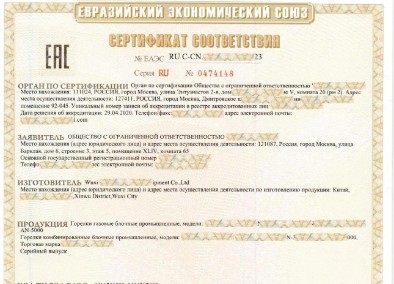
2. Evolution from CU-TR to EAEU TR
Before 2015 – The Customs Union (CU)
Prior to January 1, 2015, all conformity declarations used the **Customs Union (CU)** heading.
At that time, the Customs Union included only three member states:
* Russia
* Belarus
* Kazakhstan
The corresponding declarations were called **CU-TR Declarations of Conformity**.
After 2015 – The Eurasian Economic Union (EAEU)
On **January 1, 2015**, the Customs Union was officially renamed the **Eurasian Economic Union (EAEU)**. The EAEU now includes five member countries:
* Russia
* Belarus
* Kazakhstan
* Armenia
* Kyrgyzstan
Since then, all declarations are issued under the **EAEU** heading instead of **CU**, and all technical regulations have been rebranded accordingly.
---
3. Key Updates in the EAEU (EAC) Declaration
1. Document Header – All EAC Declarations now display the “Eurasian Economic Union (EAEU)” title instead of “Customs Union (CU)”.
2. Registration Code – The registration number prefix has changed from **CU** to **EAEU**.
3. Regulation Name – The former “CU TR” designation is now “EAEU TR”. However, many people still use the old term **CU-TR Declaration** out of habit.
In summary, **CU-TR and EAEU TR Declarations are the same in essence**.
The EAEU has simply replaced the CU system, and all related regulations have been updated accordingly.
4. Registration and Legal Validity
Applicants can register the **EAEU Declaration of Conformity** in **any member country** of the Eurasian Economic Union. Duplicate registrations are allowed.
There is **no fixed certificate format**—it is typically issued on **A4 paper**. The declaration must be officially registered with a **government-accredited body** in one of the EAEU member states to ensure authenticity.
After registration, the declaration must be **signed and sealed** by the applicant and can be attached to **shipping or customs documents** as proof of conformity during **customs clearance and sales**.
5. When Is an EAC (EAEU TR) Declaration Required?
The EAC Declaration is **mandatory** for exports of:
* Industrial machinery and equipment
* Packaging materials
* Perfumes and cosmetics
* Grain and food products
* Furniture (excluding children’s furniture)
* Lubricants and oils
The applicable declaration or certification (EAC Declaration or EAC Certificate) depends on the **specific product category and technical regulation**.
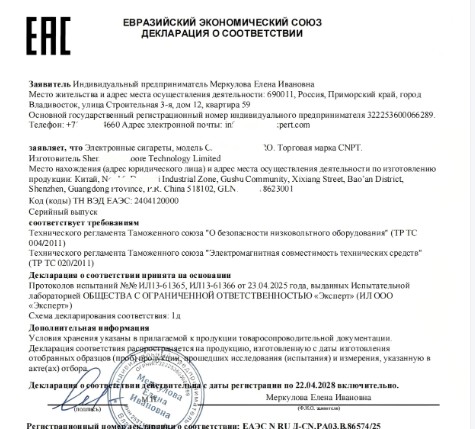
For example:
**Household air conditioners** fall under **TR CU 004/2011 and TR CU 020/2011**, requiring a **Certificate of Conformity**.
**Industrial air conditioners** fall under the same technical regulations but require a **Declaration of Conformity**.
6. Main EAEU / CU-TR Technical Regulations
Below are key **technical regulations (TR CU / EAEU TR)** applicable to EAC Declarations:
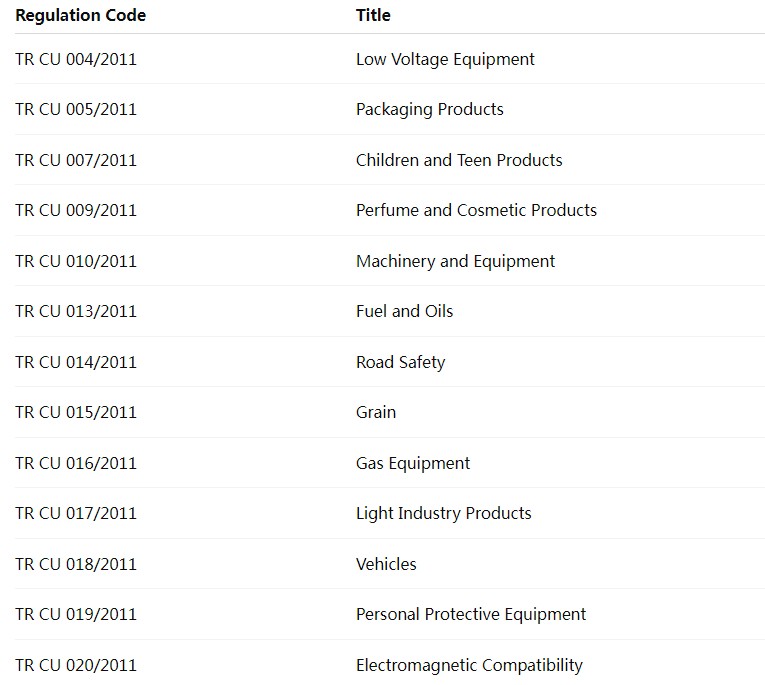
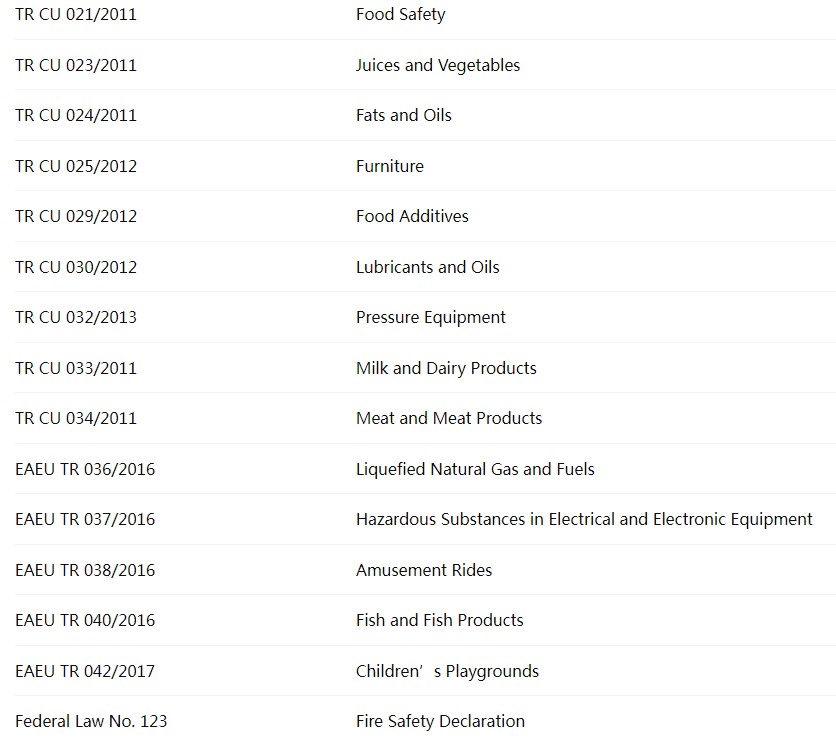
7. Required Documents for EAC (EAEU) Declaration Registration
Each technical regulation specifies its own document list, but generally, the following are required:
1. Application Form
2. Technical Documentation(Product passport, manual/instructions, safety justification, product description)
3. Test Reports (if available)
4. ISO 9001 Certificate or HACCP Certificate (if available)
5. Trade Contract and Commercial Invoice – required for single-batch schemes (2D, 4D)
8. Registration Procedure
The **EAC Declaration registration** is relatively simple but must be handled carefully, as **the applicant bears full responsibility** for the accuracy of all submitted data.
Before registration, experts verify all information, technical documentation, and testing reports to ensure compliance with the relevant technical regulations.
If laboratory testing is required, **product samples** must be sent to an **accredited EAEU laboratory**.
With professional assistance, the **EAC Declaration process can be completed in as little as 1–3 working days**.
9. Validity Period of the EAEU (EAC) Declaration
The **maximum validity** of an EAEU Declaration of Conformity is **five years**.
For **single-batch shipments**, there is no set expiration date—the declaration remains valid for that specific shipment or the **product’s service life**, as indicated in the document.
Each manufacturer may define its own product lifecycle, which must be stated in the EAC Declaration accordingly.

✅ In summary, the EAEU (EAC) Declaration of Conformity ensures that products exported to the Eurasian market comply with technical and safety standards.
It replaced the older CU-TR system in 2015, unifying certification requirements across the five member states of the Eurasian Economic Union.
WWW.YIMIRE.COM
3-4 STEPS TO GET OUR PRODUCTS

Order & Ship
Place production order then sit back, relax and allow us to take care of the rest.

(Optional) Customization
You can also make partial modifications to the product according to your requirements.

Quote & Sample
Let you receive the quotation fast.
Before placing the order, we can send you the sample for testing.

Order & Ship
Place production order then sit back, relax and allow us to take care of the rest.